The Hidden Engineering Work Behind “Simple” Product Features
When users say a product feels simple, that is usually a compliment to the engineering team. Simplicity in software is rarely accidental. It is almost always the result of deliberate, invisible work designed to absorb complexity before it ever reaches the user.
The challenge is that this hidden effort is often underestimated. Features that look trivial in demos or mockups routinely become some of the most demanding parts of a system. Timelines slip. Estimates are questioned. Engineering teams struggle to explain why something that “looks easy” is not.
That gap exists because simplicity is a user experience, not an engineering reality.
Why “simple” features are consistently underestimated
Product requirements describe behavior, not systems. A login screen shows two input fields and a button. A notification appears as a small pop-up. A report looks like a table of numbers. None of these visuals reveal what must happen underneath for the feature to work reliably in production.
Early demos reinforce this misunderstanding. They run under ideal conditions. There is limited data, predictable flows, and no real user behavior to stress the system. Once a product is live, those assumptions collapse.
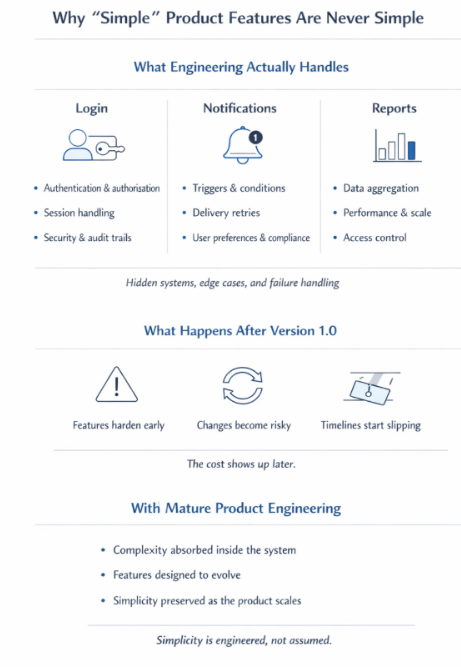
Engineering effort increases not because teams overbuild, but because real users introduce variation, scale, and failure modes that were never visible on a wireframe.
“Just add a login” is never just a login
Authentication is one of the first features most products to implement, and one of the most underestimated.
On the surface, login looks solved. Frameworks provide templates. The UI is minimal. Login is not a screen. It is a security system with usability constraints.
It must handle session lifecycles, credential recovery, token expiration, rate limiting, audit trails, multi-device behavior, and failure scenarios. It must balance friction with protection. As the product grows, it must evolve to support roles, permissions, integrations, and compliance requirements.
Early shortcuts here harden quickly. Temporary decisions become permanent foundations. Changing them later becomes risky because authentication touches every part of the product. The simplicity of the user's experience is supported by engineering decisions that must be correct from day one.
Notifications are distributed systems in disguise
Sending a notification feels trivial until the first one fails.
Notifications depend on triggers, timing rules, user preferences, delivery guarantees, and external services. They require retry logic, deduplication, and failure handling. They must respect opt-out requirements and compliance constraints while remaining fast and reliable at scale.
Under the hood, notification systems behave like distributed systems. Messages are queued, delayed, retried, and sometimes canceled. Silent failures are particularly dangerous because users assume the system worked when it did not.
When notification logic is treated as an add-on, it quickly becomes one of the most fragile parts of a product. When engineered deliberately, it disappears from user awareness entirely.
“Just show a report” hides the heaviest systems work
Reporting features are another common source of surprise.
A report is not just data displayed on a screen. It is a decision about how data is modeled, aggregated, filtered, secured, and refreshed. It must balance accuracy with performance. It must enforce permissions at the data level. It must handle time zones, exports, and historical consistency.
Poor reporting architecture creates ripple effects across the product. Queries slow down. APIs strain under load. Features that rely on the same data begin to degrade. What started as a simple reporting request quietly becomes the most resource-intensive part of the system.
Good reporting feels effortless because the complexity has already been handled where users cannot see it.
The real cost appears after version 1.0
Many of these features work well enough at launch. The real cost surfaces later.
Once a feature becomes foundational, other features depend on it. Workarounds accumulate. Edge cases multiply. The effort required to change behavior increases with every release.
This is where engineering decisions begin to show their business impact. Features that were never engineered to evolve start creating friction for users. Small inconsistencies compound. Over time, these issues do more than slow delivery. They affect reliability, trust, and retention.
This pattern is especially visible when looking at product engineering decisions that drive SaaS churn, where hidden technical constraints quietly degrade user experience long after launch.
Accidental simplicity is a hidden risk
Some features appear simple because they were never designed intentionally. They work because they have not been stressed yet.
These are often the most dangerous features in a product. They lack clear ownership, extensibility models, and failure boundaries. When requirements change or scale increase, they fail unpredictably.
Engineering teams usually discover these weaknesses when customers already depend on the feature, and changes carry real business risk. At that point, fixing the problem is far more expensive than engineering it correctly upfront.
What mature product engineering does differently
Strong product engineering treats “simple” features with respect. Not because they are complex today, but because they will evolve tomorrow.
Mature teams design features as platforms, not patches. They anticipate variation. They isolate concerns. They define clear contracts and failure behavior. They invest early in observability, so behavior under load is visible, not guessed.
Most importantly, they recognize that hiding complexity from users requires absorbing it inside the system. That absorption must be intentional, not accidental.
This is how engineering teams protect long-term velocity while preserving a clean user experience.
Simplicity is built, not assumed
Users judge products by how easy they feel. Engineering teams build the conditions that make that possible.
When simplicity feels effortless, it is usually because someone worked hard to make it so. The invisible work behind simple features is not a waste. It is what allows products to scale, adapt, and remain usable as they grow.
The next time a feature sounds simple, the right question is not whether it can be built quickly, but whether it can evolve safely. Teams that invest early in Software Product Engineering Solutions are the ones able to deliver products that stay simple on the surface while remaining resilient underneath.